
Grief Hurts
Grief hurts even in fiction:
The truth is grief weighs heavy and the confusing sorrow makes even breathing difficult. Tears help us recognize sadness in someone else. The body might shake or tremble. Lips often quiver while we attempt to control the waves of emotions. And physical aches amplify our brokenness.
Often, it’s easier not to share those truths with another. Vulnerability stings like arrows flung from familiar bows.
Sometimes we don’t see visible grief when someone hides behind a smile.
What if no one cared what happened to us last year or ten years ago. What about during our childhood? That might be a lifetime ago. But memories prick and the grief returns as if the loss happened moments ago.
Writing from a place of grief:
As a writer, the characters we write also need to be realistic and believable to touch our readers. But what if they hide their grief or secret feelings behind a mask?
We might create dialogue that fuels contention and disagreement and all the things that separate us, because a good story needs increasing conflict to be compelling.
To be interesting.
To keep readers focused on learning more.
To keep the drama alive.
Perhaps we want our characters conflict to be larger than our life because of all those things.
Or perhaps grief, loss, and heartache have been part of a story for so long that we relate to the sorrow and feelings of anger or confusion.
When the character in our latest novel spills a part of our own story in a surrealistic reality, we react in different ways than if we were indeed the character. Intellectually, we know they are not us. We understand the elements of story. We believe that our writing reflects truth and honesty, but we must make that story resonate with our readers.
There is an uncanny truth that permeates our stories because we write what we know and what we want to be true for our characters. We identify with the conflict and sometimes think, I’m glad I don’t have it as bad as that. Somehow feel better or we justify that character would emotionally fall apart if the things that happened to me in real life happened to them.
Is that realistic? Or sensational? Or does writing from a place of knowing and experiencing grief make our writing believable?
Sharing my grief story with others:
At the Florida Christian Writers Conference this week, I attended Hallee Bridgeman’s class about writing realistic fiction. The uncomfortable parts of my life crept into my mind. Could I be so vulnerable and open?
I’ve experienced the ugly parts of growing up in an abusive family that no one speaks about. I’ve suffered childhood trauma that is often easier to hide than to share. To be candidly honest, it’s much, much easier to hide the truth of grief.
Honest reflections are sometimes best brought to God and laid at the feet of Jesus.
But when sharing our not-so-common struggles, we become more real. Genuine. And believable. It’s then our hearts can heal.
We all experience different levels of grief and can find comfort in knowing that although our story is filled with drama and sometimes unbelievable reality of suffering, we know that we can step out a little more confidently.
What would I do if I were [fill-in the blank of your favorite character name] and how would they handle what I went through at their age?
It’s not easy sharing the details of our own struggles and trials. It isn’t easy to pull out those arrows. We bleed. We cry and shrink from fear.
Some people (and characters) walk through the same struggles and rise stronger on the other side of the next trial. And no matter what truth arises about our reaction to grief, we have the Lord Jesus with us holding us, balancing us between now and the tomorrow, and loving us no matter how we feel about the messy and ugly pieces of yesterday.
We can handle whatever arrows are flung at us or around us or through us.
We can be stronger.
The stories we write help us (and our readers) rise above regret, fainting, or hopelessness, and we (and our readers) become stronger and kinder.
I love to hear stories about those who bravely pull back the mask they’ve been wearing, and wade into the reality that is life—a messy, lonely, grief-laden world. We lift one another and comfort each other with the comfort that comes from God Himself.
Because tears are not always, and we don’t often see behind the masks people wear.
But we can show grace upon grace and step into God’s story to be more like Jesus.
Childhood losses and understanding:
I am a writer, author, artist, and poet. I write about hope after loss and comfort through grief. My debut children’s picture book, Grief Like Rain—Hope Like Sunshine, is a small part of my truth in fiction.
Remembering the death of my grandma when I was around twelve and experiencing the emotions of grief when I lost my mom in my early twenties, here is the “why” of my fictional picture book.
Why I Wrote Grief Like Rain
Grief is one of the hardest emotions for children and adults to understand. Adults often struggle to find the right words to explain grief that never quite disappears.
As a child, several experiences shaped how I understood grief and loss. I remember the power of storms—the sound of rain and thunder—and the awe of standing outside while the sky opened above me or tornadoes barreled toward our home on a hill. Rainstorms fascinated me but also frightened me.
When I was nine or ten years old, a frightening experience with near drowning left me with a deep awareness of the power of water and storms, both physically and emotionally.
Around that same time, our basement flooded with mud during a torrential downpour. I watched the rain transform my play area into something chaotic.
Later, when I lost my grandmother, the loss and grief carried that same feeling of a storm that appeared and swept familiar things and people away.
My parents divorced during my ninth and tenth grade high school years. My father left home. Like the experience of a death of a parent, I wondered how others made sense of the sadness.
I carried my own questions into my college years. Sometimes grief weighed heavy and overwhelming. Other times, rain felt refreshing and comforted me like kisses from Heaven.
But when my mom died during my early twenties, I knew she would meet God, although sadness from her loss still lingers even in my sixties.
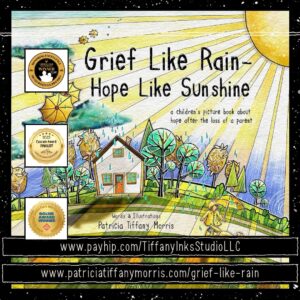 Grief Like Rain—Hope Like Sunshine uses the imagery of storms, raindrops, and light to help children understand difficult emotions. My hope is that this book gives families a gentle way to talk about grief, loss, and healing together. Because even the heaviest rain eventually gives way to the light from God.
***
November is Children’s Grief Awareness Month.
Orders are open for a high quality paperback and hardback version of Grief Like Rain—Hope Like Sunshine at my Payhip Store (Integration with Bookvault and their POD direct sales through my website or direct from Payhip.) The KDP and Ingramspark versions will be uploaded in the near future, as will the eBook and audiobook versions.
BOOKVAULT PAYHIP STORE:
https://payhip.com/TiffanyInksStudioLLC
SQUARESPACE WEBSITE BOOK PAGE:
https://www.patriciatiffanymorris.com/grief-like-rain
PRAYER TEAM:
Join me for a “choose your own participation” launch of Grief Like Rain—Hope Like Sunshine. This won’t be a typical launch. Sign up and choose from a list of options. Or just sign up to pray and receive updates.
https://forms.gle/95xNywbYCiuLmaor7
 From her Iowa studio, Patricia Tiffany Morris, eclectic illustrator and author of poetry, children’s books, and fiction, weaves God’s hope through storms of grief. Her technical affinity and creative arts background assist her through book layout, cover design, and hand-lettered font creation.
Patricia studied architecture and graduated with a BA, a BArch, and three credits short of a dance minor. She taught speech, drama, and a variety of courses for the homeschool community.
Fueled by Mac tools and custom Procreate brushes, she illustrates stories on her iPad Pro with the Apple Pencil and scribbles ideas in her sleep.
Published in Guideposts, Lyrical Iowa, NFSPS Prize Poems, Grant Wood County Chronicle, Enliven Devotionals, and other anthologies, Patricia has earned over 60 awards since 2019, including winner of 2026 SELAH Poetry Award (2026). Her debut picture book won several awards: “Best in Contest” at WCCW and 4 awards from Children’s Book International (American Writing Awards 2023-2024).
Patricia co-directs the ACFW Kingdom KidLit Contest and enjoys teaching and sharing ideas and tools with fellow writers. Tears are not always wet™ is the trademark of Tiffany Inks Studio LLC.